

.png)
.jpg)
How Is the Centrifugal Blower Turned? 5 Steps Explained Simply
How Is the Centrifugal Blower Turned? 5 Steps Explained Simply
1. What Is a Centrifugal Blower? A Simple Introduction for First-Time Users
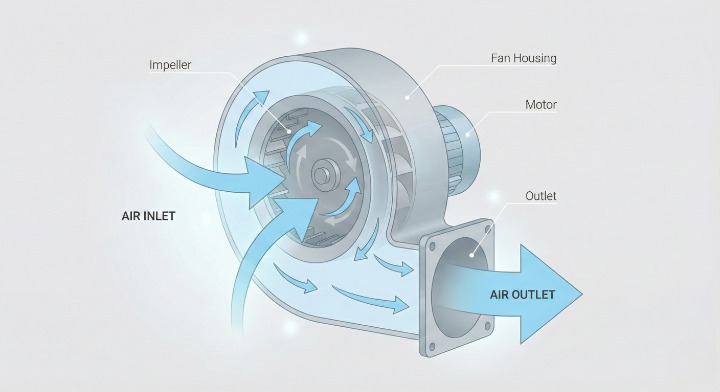
If you’ve ever searched “How is the centrifugal blower turned?” or “How does a centrifugal blower work?”, you’re already on the right path. A centrifugal blower is a type of fan used in homes, offices, vehicles, and industrial equipment to move air using centrifugal force.
Unlike axial fans that push air straight forward, a centrifugal blower pulls air in from the center and pushes it out from the side at a 90-degree angle. This unique airflow direction makes the blower:
- More powerful than regular fans
- More effective at pushing air through ducts
- Better at handling dust and resistance
- More reliable for long-term ventilation
Where You Commonly Find Centrifugal Blowers
Even if you don’t realize it, you encounter centrifugal blowers in everyday life:
- Kitchen range hoods
- Home HVAC blowers
- Bathroom exhaust fans
- Air purifiers
- Vacuum cleaners
- Car air-conditioning systems
- Workshop dust collectors
These machines all depend on how the centrifugal blower is turned to create strong, stable airflow.
Understanding the turning process helps consumers choose the right blower for ventilation, cooling, or filtration systems.
2. How the Motor Starts Turning the Centrifugal Blower
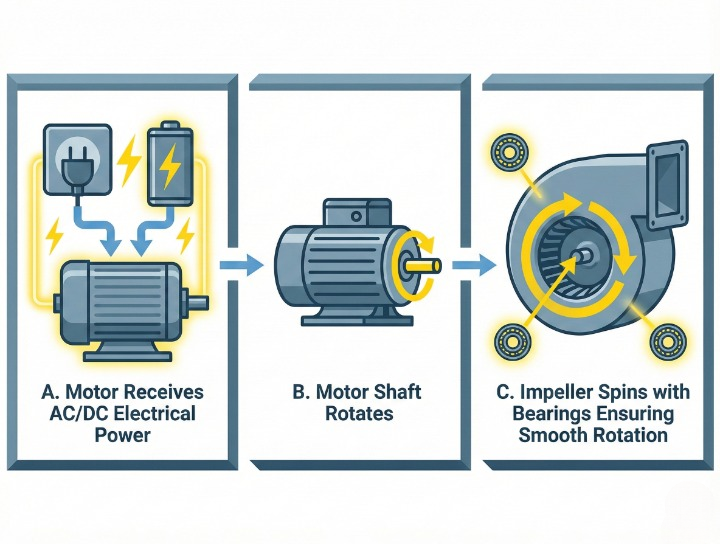
The first step of how a centrifugal blower is turned starts with the motor.
Think of the motor as the “engine” that powers the blower.
When electricity is supplied to the blower:
Step A — The Motor Receives Power
The blower connects to either:
- AC power (home ventilation, appliances)
- DC power (automotive systems, electronics, energy-saving equipment)
Both types power the motor shaft, which begins to rotate.
Step B — The Motor Shaft Turns the Impeller
The shaft is connected directly to the impeller (the rotating wheel with blades).
As the shaft spins, the impeller begins turning immediately.
Step C — Bearings Ensure Smooth Rotation
Inside the blower are ball bearings or sleeve bearings, which support smooth turning by:
• Reducing friction
• Lowering noise
• Increasing lifespan
Why This Step Matters
Without motor rotation, nothing else happens.
This is where the centrifugal blower begins to transform electrical energy into mechanical movement, creating the foundation for airflow.
For general consumers, the key takeaway is this:
➡️ A centrifugal blower turns because the motor drives the impeller using rotating energy.
3. How the Impeller Rotates to Create Centrifugal Force
Once the motor turns the shaft, the impeller begins rotating—this is the heart of how the blower works.
A centrifugal blower impeller looks like a round wheel with multiple blades. As it spins:
Step A — Air Is Pulled Into the Center
The spinning motion creates a low-pressure zone at the center, which naturally pulls air inward.
Step B — Centrifugal Force Pushes Air Outward
As the impeller rotates, centrifugal force pushes the air toward the outer edges of the blower.
Imagine swinging a bucket of water in a circle—the water pushes outward and stays in place.
The blower works the same way.
Step C — Air Speeds Up as It Moves Outward
The faster the impeller spins, the stronger the airflow.
High-speed rotation = stronger air pressure.
Impeller Blade Types Affect Performance
Different blades create different results:
- Forward-curved blades → quieter, higher airflow
- Backward-curved blades → more efficient, higher pressure
- Radial blades → best for dust-heavy applications
Why This Step Matters
This is the moment where mechanical rotation becomes airflow energy.
Without the impeller turning, a centrifugal blower cannot:
- Build pressure
- Move air through ducts
- Handle ventilation resistance
This step explains the keyword question “How is the centrifugal blower turned?” — by converting rotation into airflow through centrifugal force.
4. How Air Moves Through the Blower: From Inlet to 90-Degree Outlet
This is the stage where turning motion becomes controlled airflow.
Step A — Air Enters Through the Inlet
The inlet is the front or center opening.
The rotating impeller pulls air in naturally due to pressure differences.
Step B — Air Moves Into the Scroll Housing
The scroll housing is a spiral-shaped casing surrounding the impeller.
Its job is to:
- Guide airflow
- Compress air
- Increase air pressure
- Reduce turbulence
Step C — Air Is Redirected at a 90-Degree Angle
This is the key difference between centrifugal blowers and axial fans.
Axial fan = air goes straight
Centrifugal blower = air exits sideways
This side-exit movement makes centrifugal blowers ideal for:
- HVAC ducting
- Range hoods
- Filtration units
- Multi-room ventilation
- Heat or smoke extraction
Step D — Air Exits the Outlet with Higher Pressure
The air leaving the blower has:
- Higher speed
- Higher pressure
- More directional control
This allows the blower to push air through long pipes or upward vents without losing performance.
For beginners:
➡️ The blower turns air in a circle, then redirects it outward through a side outlet to create strong airflow.
5. What Happens During Operation: The Complete Turning and Airflow Cycle Explained
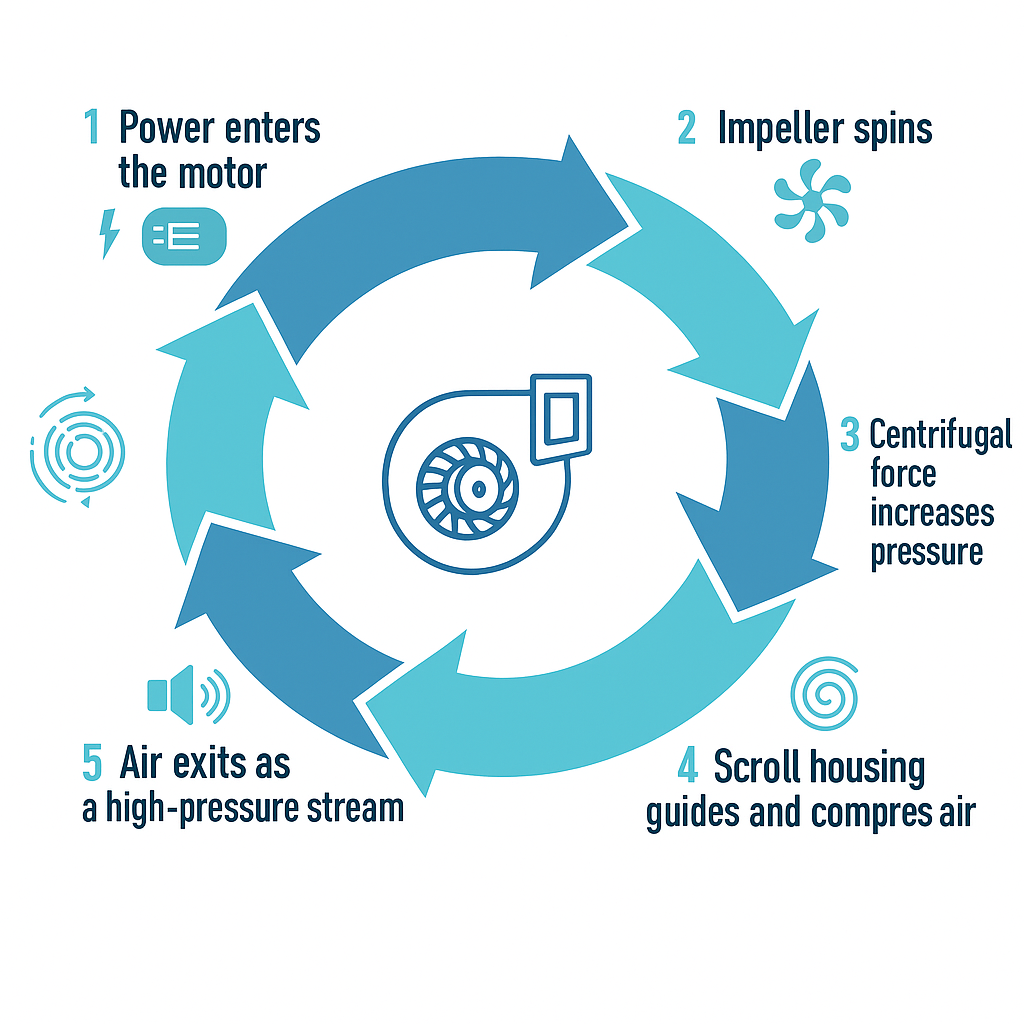
Now that you understand the turning steps, here is how the full cycle works when the blower is operating normally:
1. Power enters the motor.
Electricity starts the motor shaft turning.
2. The impeller spins.
Blade rotation pulls air into the center.
3. Centrifugal force increases air pressure.
Air is thrown outward at high speed.
4. The scroll housing compresses and guides airflow.
Converts chaos into controlled movement.
5. Air exits the outlet as a high-pressure stream.
Ready to move through ducts, filters, or rooms.
This process repeats thousands of times per minute as the blower continues running.
Why This Cycle Is Important for Consumers
Understanding this 5-step cycle helps buyers choose the right blower for:
- Long duct ventilation
- Kitchen exhaust systems
- Home HVAC systems
- Workshop dust extraction
- Industrial cooling and airflow control
When you understand how the centrifugal blower is turned, you know exactly why it performs better in demanding environments than a standard fan.
10 Frequently Asked Questions (FAQ)
1. How is the centrifugal blower turned?
The blower is turned by an electric motor that spins the impeller, creating centrifugal force that moves air.
2. What powers the turning motion?
Either an AC motor or a DC motor drives the impeller.
3. Does the blower turn fast?
Yes—impellers typically rotate from 1,000 to 4,000 RPM or higher.
4. Why does the airflow come out the side?
Because the blower uses centrifugal force and a scroll housing that redirects air at 90 degrees.
5. What happens if the blower stops turning?
Airflow stops completely. This usually indicates a motor, bearing, or power issue.
6. Are centrifugal blowers more powerful than axial fans?
Yes. They produce higher pressure and are better for ducted systems.
7. What makes the impeller turn smoothly?
Ball bearings or sleeve bearings reduce friction and noise.
8. Can dust affect how the blower turns?
It can, but centrifugal blowers are more dust-friendly than axial fans.
9. Are they energy-efficient?
DC and EC motor centrifugal blowers are highly efficient.
10. Where can I buy reliable centrifugal blowers?
Browse high-quality models here:
👉 https://www.coolingfanmanufacturers.com/Category/4/Centrifugal-Blowers
________________________________________
Conclusion
Understanding how the centrifugal blower is turned helps consumers appreciate why this type of fan is widely used across residential, commercial, and industrial applications.
Because the blower:
- Uses centrifugal force
- Turns air at a 90-degree angle
- Creates strong airflow
- Maintains pressure through ducts
- Handles resistance well
- Offers reliable long-term operation
…it is one of the best choices for any environment requiring powerful, stable, and durable airflow.
This simple 5-step explanation gives beginners the confidence to choose the right centrifugal blower based on how it works and what their application needs.
.jpg)
.jpg)
.jpg)
.jpg)
.jpg)
.jpg)
.jpg)
.jpg)